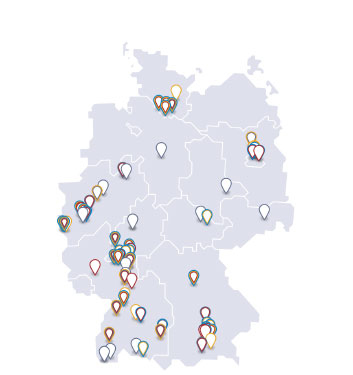
The new report “Medical Biotechnology in Germany 2011 – Biopharmaceuticals: Economic data and benefit of personalized medicine” is now available. It was provided by The Boston Consulting Group for vfa bio. This yearly report is the only one recording all activities within medical biotechnology in Germany – ranging from startup to big companies.
In 2010, the demand for biopharmaceuticals - that is, recombinant drugs - continued to grow in Germany. The importance of biopharmaceuticals has thus further increased, aided by 114 (2009: 112) small and medium-sized biotech companies, medium-sized and large drug manufacturers, and German subsidiaries of international pharmaceutical and biotech companies which are already marketing products and/or have their own innovative product pipelines, as well as 269 (2009: 268) companies with technology platforms (but no own drug development).
- The number of employees in medical biotechnology showed slight growth compared with 2009 (+2% compared with the previous year).
- Sales of biopharmaceuticals in 2010 increased by some 8% to approx. €4.9 billion compared with the previous year (adjusted for the mandatory rebate). In the same period, the total pharmaceutical market grew by more than 3%. The share of biopharmaceuticals thus increased to 17% (2009: 16%) of the total pharmaceutical market in Germany. As a result of the price moratorium in effect since August 2009, the increase in sales of biopharmaceuticals can be attributed exclusively to the increased medical need.
- Biopharmaceuticals are represented strongly in certain fields of therapy. For example, their revenue share is 74% in immunology, 35% in the area of metabolism, 32% in oncology, and 23% in hematology.
- In 2010, 6 of the 22 newly approved drugs were biopharmaceuticals (27%).
- 516 biopharmaceuticals were in clinical development in 2010. Compared with 2009, the pipeline grew by 12%. The development focus was particularly on cancer drugs and vaccines.
The focus of this year's study is on personalized medicine. In this therapy concept, certain drugs are administered only after a preliminary test that determines whether the drug is likely to benefit the patient without causing problematic side effects. Thus, discontinuation of treatment or ineffective therapy attempts can be avoided. The greatest medical benefit of personalized medicine is thus that the patient quickly receives the best suited drug. This increases both the quality of care and the quality of life. In addition, personalized medicine can increase cost efficiency in the health care sector through more efficient use of existing funds and resources, thus helping to maintain the performance of the health care system at the current high level. To achieve this, all players in health care must create the best possible conditions to establish personalized prescriptions beyond the niches existing today.
Here you can find the complete BCG report 2011 "Medical Biotechnology in Germany 2011 – Biopharmaceuticals: Economic Data and Benefit of Personalized Medicine" in german language as PDF download file.